
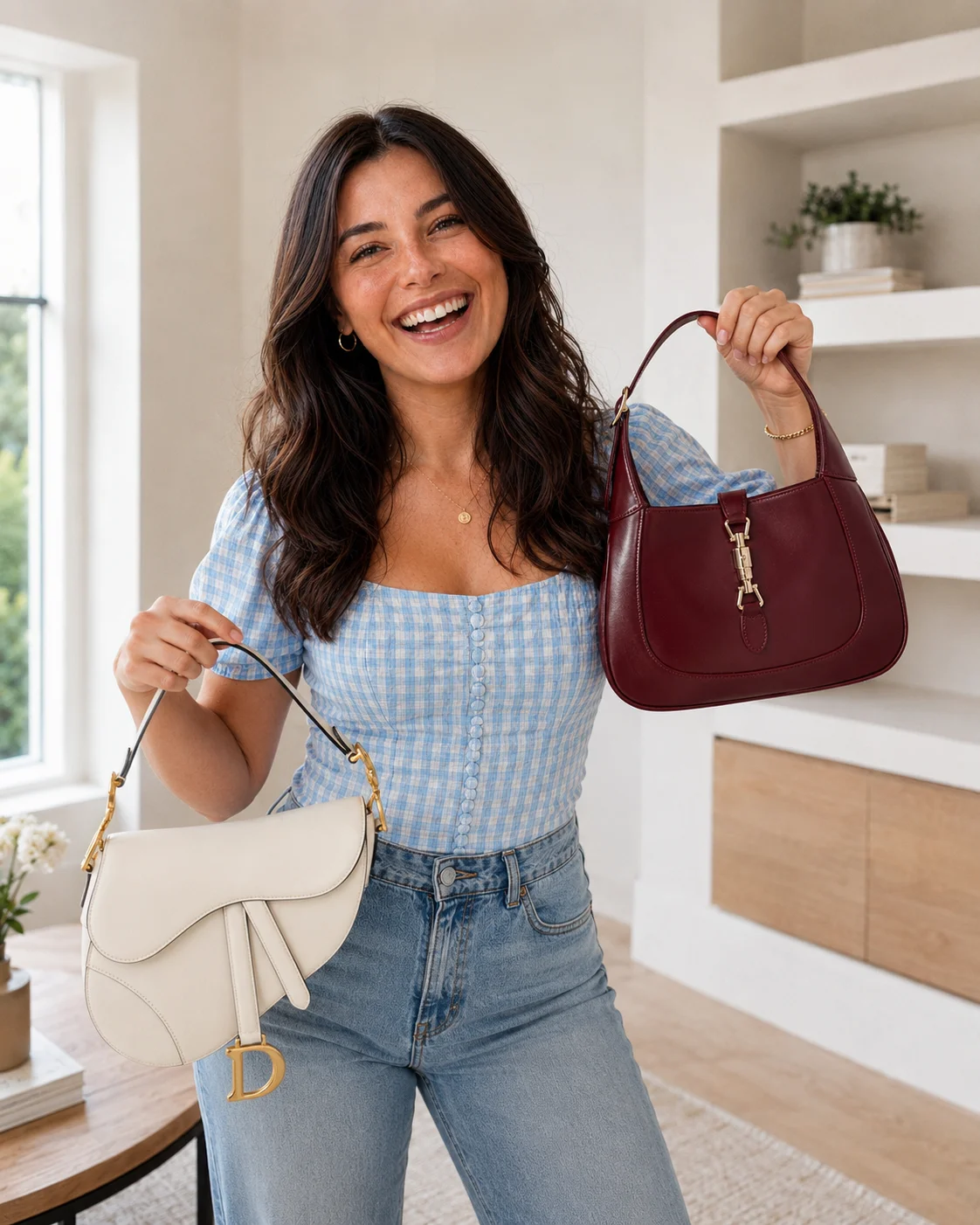
Somebody posts a fresh set of QC photos and suddenly everybody’s zooming into the heat stamp until the picture turns into a blurry mess. They’re counting stitches like they’re auditing tax returns. They’re comparing a serial card against some random screenshot a stranger posted on a forum three years ago. Somebody circles one tiny thread in red and the entire conversation starts spiraling.
Meanwhile, the actual bag is sitting right there on the table, practically screaming.
The handle drop looks strange. The edge paint is too thick. The leather looks flat and plasticky. The hardware has that bright yellow finish that photographs badly and looks even worse in daylight. The flap doesn’t sit right. The chain feels heavy, which sounds impressive until the color, movement, and clasp tell a completely different story.
We get so caught up in the tiny details that we miss the obvious things staring us right in the face.
And then there’s the opposite problem. People reject perfectly decent replica bags over things that aren’t always problems in the first place.
I’m not here to tell you every flaw deserves a pass. I’m also not starting a war over one loose thread I can trim in five seconds.
I care about the things that actually change the bag: the materials, the construction, the hardware, the glazing, the edge paint, the straps, the closures, and what the seller photos really prove once you stop getting distracted by one dramatic close-up.
This guide is where I’m putting all of that in one place. We’re going to talk about replica bags, replica handbags, seller tiers, QC photos, leather, zippers, linings, hardware, and all the labels people throw around like they mean the same thing everywhere.
AAA. Triple A. 1:1. Mirror quality. Superfake.
Some of those terms can be useful inside one seller’s catalog. None of them should do your thinking for you.
Before we get into any of that, though, we need to clear up the biggest misconception first.
Authentic Bags Aren’t Perfect Either
One of the strangest things about the replica world is how quickly people start comparing a bag against a fantasy version of the authentic one that doesn’t actually exist.
You’ll see somebody reject a replica handbag because the leather feels slightly firmer than the leather on an older bag she found in a resale listing. Or because one piece of leather has a little more grain than another. Or because a zipper doesn’t glide like butter straight out of the box.
I’m not saying you should ignore obvious problems. If the coating is peeling, the hardware is seriously crooked, the straps feel unstable, or the material is obviously synthetic when the bag is supposed to be real leather, that matters.
But real leather isn’t made in a laboratory. It came from an animal. Different hides can have different grain, texture, softness, markings, and color variation. Even pieces cut from the same hide aren’t always going to behave exactly the same way.
A fresh leather bag can also feel stiffer than a bag that’s been carried for months or years. Some leather softens with regular use. Some develops a deeper color and patina. Some finishes stay more uniform. None of that means every stiff bag is secretly amazing, but it does mean “this feels different from my older bag” isn’t a complete review.
That can be a useful clue. It isn’t a final verdict.
The same goes for zippers. A new zipper can feel a little stubborn. Sometimes it smooths out with normal use. Sometimes the right zipper lubricant helps. That’s completely different from a zipper that keeps catching because the teeth, slider, or construction are wrong.
And please make sure you’re comparing the right bags in the first place.
The same model name can show up across different sizes, seasons, materials, linings, straps, and hardware finishes. Designers revisit their own bags all the time. A current release in grained leather shouldn’t be judged against an older version in smooth leather like they came off the same cutting table.
My rule is simple: compare the same model, the same size, the same material, and the closest possible release. If you can’t do that, you may still have a useful clue. You don’t have a final verdict.
I Don’t Turn Every Tiny Flaw Into a Crisis
I’ve seen women panic over one loose thread they could trim in five seconds. I’ve seen people write off a bag because it smelled a little strange after spending days sealed inside packaging and traveling across the world.
I’m realistic about what I’m buying.
If a bag needs a little time to air out, I give it time. If the leather needs regular use before it relaxes, I carry it. If there’s one tiny frayed thread I can clean up without making a mess, I’m not starting a war over it.
I care about the problems that change the bag: bad materials, peeling finishes, proportions that look wrong, hardware that feels cheap, straps that won’t hold up with a light load, closures that don’t work, and sellers who dodge reasonable questions. And if you don’t know, see what cheap really means once the bag starts wearing.
There’s a difference between paying attention and expecting a level of perfection the authentic brands don’t consistently deliver themselves.
Before You Panic, Give a Fresh Bag a Minute
Some problems are obvious the second you open the package. Others need a little context.
A bag has probably spent days sealed inside packaging, traveling across the world, and sitting in temperatures nobody involved would describe as ideal. I don’t expect every fresh bag to arrive feeling like it’s already been carried gently for a year.
A strong smell is information. It isn’t automatically a disaster.
New leather bags can carry a smell from dyes, finishing products, adhesives, packaging, or the trip itself. If the odor is mild and starts fading once the bag gets fresh air, I’m not panicking.
I usually let the bag air out somewhere shaded and well ventilated. If the smell lingers, I’ll place baking soda in a small open container or breathable sachet inside the bag for a couple of days. I’m not dumping loose powder all over delicate leather and creating a second problem because the first one annoyed me.
What gets my attention is an odor that stays harsh after airing out, especially if it comes with tacky coating, peeling material, or a surface that feels more like plastic than leather.
Fresh leather and bad leather aren’t the same thing.
Some real leather starts out firmer and relaxes with use. The grain can vary. The texture can vary. The way one section of the hide takes color can vary slightly from another.
That doesn’t mean every stiff bag deserves blind optimism. There’s a difference between leather that needs time to soften and a synthetic surface that stays rigid, cracks, or starts peeling at the edges.
Patina also gets misunderstood constantly. Real leather can soften, darken, and develop character with age, but the finish matters. Some leathers show that change dramatically. Others have a heavier coating and stay much more uniform.
And pigskin is still real leather. It shouldn’t be thrown into the same category as PU, PVC, or plastic just because it isn’t the leather somebody expected.
A stiff zipper deserves a closer look, not an immediate funeral.
New zippers can feel a little tight at first. Sometimes regular use is enough. Sometimes a small amount of the right zipper wax or lubricant helps the slider move more smoothly.
I pay attention to whether the zipper improves and whether it moves consistently. A zipper that’s simply fresh is one thing. A zipper that keeps catching in the same place, separates, scrapes badly, or feels misaligned is a different issue.
The pattern matters more than one isolated annoyance.
One tiny thread, a fresh zipper, or a bag that needs a day to air out doesn’t scare me. A combination of peeling material, unstable straps, rough closures, crooked hardware, and a seller who suddenly stops answering questions does.
That’s the difference between being realistic and talking yourself into a bad bag.
QC Photos Can Tell You a Lot. They Can Also Hide a Lot.
QC photos are one of the most useful things a seller can send you. They’re also one of the easiest things to overtrust.
A seller doesn’t have to send fake photos to give you the wrong impression of a bag. Sometimes the photos are completely real and current. They’re just flattering.
The bag is stuffed perfectly. The angle makes the base look more even than it is. The hardware is catching warm indoor light. The glazing looks clean because the photo never gets close enough to show the edges. The side profile is missing entirely.
None of that automatically means somebody’s trying to hide something. But it does mean one pretty front-facing photo isn’t enough.
I like QC photos, or PSPs if that’s what your seller calls them, because they give you a chance to catch the problems that actually matter before you get emotionally attached to one flattering angle.
I Want to See the Bag Before It Gets Posed Like It’s on a Red Carpet
The first thing I want is a normal front photo with the bag sitting upright on a flat surface. Not hanging from somebody’s hand. Not tilted backward. Not half-hidden behind tissue paper and protective plastic.
Then I want the back, both side profiles, the base, the top opening, and a wider shot where I can actually understand the proportions.
Stuffing can help a bag hold its shape during shipping, but too much stuffing can also make a soft bag look more structured than it’ll look once you carry it. Hanging a bag by the handles can hide a base that doesn’t sit evenly. Turning the bag slightly can make one side look cleaner while the other side quietly avoids the camera.
I’m not looking for a forensic photo shoot. I just want to see the bag resting like a bag.
My rule: a close-up can confirm a detail. It can’t rescue a bag you’ve never seen clearly from the front, back, sides, and base.
Hardware Needs More Than One Flattering Light
Hardware is one of those things that can look completely different depending on the room, the camera, and whether there’s still protective film sitting on top of it.
Warm lighting can make gold-tone hardware look more yellow. Cooler lighting can make it look paler. Reflective plastic can soften scratches, distort the finish, and make the hardware look glossier than it really is.
I like seeing the clasp, zipper pull, chain, buckles, and any engraved hardware in normal lighting without the entire photo turning into a shiny little light show.
And heavy hardware doesn’t automatically mean good hardware. I’ve seen chains that felt substantial but still looked too bright, moved awkwardly, or made the bag feel strangely unbalanced.
Weight is one clue. It isn’t the whole review.
Close-Ups Matter Once I Know What I’m Looking At
Once the wider photos make sense, then I care about the close-ups.
I want to see the glazing and edge paint around the handles, flap, and strap edges. I look at the stitching near the corners and strap attachments because those areas usually tell you more than one perfectly neat line across the front. I want to see the embossing, the heat stamp, the zipper track, the clasp, the lining, and the places where materials meet.
Corners matter too. They’re easy to ignore in a pretty front photo and easy to notice once the bag is actually in your hands.
What I don’t love is a pile of dramatic macro photos with no context. A beautifully photographed stamp doesn’t tell me whether the handles are spaced correctly. A clean zipper pull doesn’t tell me whether the side profile looks awkward. A crisp close-up of one stitch line doesn’t tell me whether the bag sits evenly on a table.
Tiny details are helpful after the bigger picture makes sense.
Measurements Are Boring Until They Save You From a Bad Comparison
Measurements don’t get nearly enough attention because they aren’t as exciting as zooming into a stamp and announcing a verdict.
I want to know the width, height, depth, handle drop, and strap length when the model makes those details important. If the bag comes in multiple sizes, I want to make sure everybody’s comparing the same one before somebody starts calling the proportions wrong.
A few millimeters won’t always change the whole bag. Leather moves. Soft bags relax. Measurements can vary slightly depending on where somebody places the tape.
But small differences can add up. A slightly wider base, a handle drop that sits too low, and a flap that runs a little long can change the entire impression even if none of those measurements looks dramatic by itself.
What I Like to See in a Useful Set of QC Photos
- A straight-on front photo with the bag resting naturally
- A clear back photo
- Both side profiles
- The base and bottom corners
- The top opening and interior lining
- The handles, strap attachments, and hardware connections
- The clasp, zipper pull, chain, and engraved hardware where relevant
- Close-ups of the glazing, edge paint, stitching, and embossing
- A wider photo that shows the proportions without a dramatic angle
- Basic measurements when the size or silhouette is easy to confuse
That doesn’t mean I need twenty-seven photos and a sworn affidavit every time.
One missing angle isn’t automatically suspicious. Sellers are busy. Photos get taken quickly. Sometimes you ask for one more picture and move on with your life.
What matters is the pattern.
If the side profile is always missing, the hardware only appears under protective plastic, the base never shows up, and reasonable questions keep getting brushed aside, that tells me more than one perfect heat-stamp photo ever could.
Some Things QC Photos Will Never Tell You
This is the part people forget.
A photo can’t tell you whether the zipper catches every third time you open the bag. It can’t tell you how the leather feels in your hand. It can’t tell you whether the lining feels thin, whether the chain pinches your shoulder, or whether the bag becomes irritating to carry after two hours.
It can’t tell you whether the handles start pulling out of shape after you add a wallet, keys, and the usual collection of things that somehow migrate into every handbag.
And it definitely can’t tell you what happens after a few weeks of regular use.
QC photos help me catch obvious problems. They don’t replace an actual wear review.
The Real Review Starts After You Carry the Replica Handbag
QC photos are useful, but they’re still photos of a bag sitting politely on a table.
The real review starts once you put your phone, wallet, keys, lip gloss, charger, sunglasses, and the random little things that somehow follow us everywhere inside the bag and carry it for a few hours.
That’s when you find out whether the handles still sit correctly once they’re holding weight. Whether the strap keeps slipping off your shoulder. Whether the clasp is annoying every single time you need your keys. Whether the zipper gets smoother with use or keeps catching in the exact same spot.
A bag can look beautiful in PSPs and still be irritating in real life.
That doesn’t always mean it’s a bad replica purse. Some authentic bags are annoying too. A tiny evening bag can still be impractical even when it’s made perfectly. A delicate finish can still show wear. A narrow strap can still get uncomfortable.
What matters is whether the bag behaves the way that specific design is supposed to behave, and whether any problems get worse once the bag leaves the shelf.
I Pay Attention to Where the Stress Travels
Every handbag has stress points.
If you load a tote, the weight travels into the handles and the places where those handles attach to the body. If you carry a shoulder bag, the strap, buckle, stitching, and hardware connections start doing more work. If you keep opening a flap bag all day, the closure and the edges around the flap get touched constantly.
That’s why I don’t only ask whether a bag looks good when it arrives. I pay attention to where the pressure goes once I start using it.
Are the handles pulling the top edge out of shape? Is the glazing around the strap attachment starting to crack? Does the base sag naturally, or does the entire bag collapse the second it’s carrying more than tissue paper? Is the hardware finish rubbing off in the places that get touched most often?
Those details tell me much more than one tiny stitch somebody circled in a forum post.
A Goyard Saint Louis Shouldn’t Be Judged Like an Everyday Tote
The Saint Louis is a perfect example of why one universal checklist doesn’t work.
It’s an unlined Goyardine tote. It’s supposed to be lightweight, flexible, and easy to carry. It isn’t supposed to stand on a shelf like a rigid little suitcase.
So I’m not expecting a Saint Louis to hold a perfectly sharp rectangular shape once it’s loaded. I’m looking at the Goyardine canvas, the print, the trim, the leather handles, the handle attachments, and how the tote settles once it’s carrying weight.
There’s a difference between a lightweight bag relaxing naturally and a bag looking flimsy because the materials or construction are wrong.
I also pay attention to the handles. Thin leather handles can darken and soften with use. That isn’t automatically a defect. But if the edges start peeling quickly, the glazing cracks badly, or the attachment points feel unstable with a normal load, that’s a different conversation.
A Gucci Jackie 1961 Has to Be Easy to Live With
The Jackie has that beautiful curved shape and the piston closure everybody notices immediately. But once you actually carry one, I’m paying attention to more than the first impression.
Does the curve still look right once the bag has your things inside? Does the strap sit comfortably at the right length? Does the piston closure open and close smoothly, or does it feel awkward every time you reach for something?
A closure can look convincing in a photo and still feel clumsy in your hand.
I also watch the leather around the opening and the strap connections. If the bag is being opened constantly, that area is going to tell you fairly quickly whether the construction feels thoughtful or whether the finish is only holding together because nobody has used it yet.
A Dior Saddle Exposes Wear in Very Specific Places
The Saddle has one of those shapes that everybody recognizes instantly. The asymmetrical flap and the D hardware are part of the whole personality of the bag.
That also means the edges matter.
I look closely at the edge paint around the flap, the curve of the body, the corners, the hardware finish, and the places where the bag gets touched every time it’s opened. If the glazing is too thick, starts cracking, or looks messy around the curved sections, it’s going to become more obvious with use.
I’m also realistic about the hardware. A little surface wear over time isn’t shocking. Hardware gets touched. Bags rub against clothing. Life happens.
But chipping, peeling, a harsh brassy finish, or hardware that feels loose after light use isn’t something I’m talking myself into accepting.
A Prada Cleo Needs to Keep Its Curve
The Prada Cleo looks simple until you realize the shape is doing most of the work.
It has that clean curved line, rounded construction, and brushed leather finish. There isn’t a lot of decoration to distract from the body of the bag, so the curve, the structure, and the surface finish have nowhere to hide.
I want to know whether the bag keeps that shape once it’s been carried. Does it soften in a way that still feels elegant, or does the body start looking warped? Does the brushed leather finish still look smooth and intentional, or does it start showing uneven wear immediately?
A minimalist bag can actually be less forgiving than a busier one. When the design is clean, every proportion and surface choice matters more.
Chain Bags Have Their Own Set of Problems
Saint Laurent bags come up constantly in replica conversations because so many women love the look of a black leather shoulder bag with a chain. They’re easy to dress up, easy to wear, and usually practical enough to become regular rotation bags.
But chain weight gets overhyped.
A heavy chain can feel expensive in your hand. That doesn’t automatically mean the finish is right, the links move smoothly, or the bag will feel comfortable after two hours on your shoulder.
I look at the color of the metal, the movement between the links, the hardware connections, the points where the chain rubs against the leather, and whether the bag still feels balanced once it’s loaded.
Sometimes a chain feels substantial and still makes the bag annoying to carry. That matters too.
Normal Wear and Bad Construction Aren’t the Same Thing
Every bag changes with use.
Leather softens. Handles darken. Corners can show a little wear. Hardware can pick up fine scratches. A lining can collect the evidence of every lip gloss you’ve ever owned.
I’m not expecting a bag I actually carry to stay frozen in its unboxing photos forever.
What I’m watching for is speed and severity.
A little corner wear after regular use is one thing. Peeling material after a handful of outings is another. Slight softening can be beautiful. A bag losing its structure immediately isn’t. Fine hardware scratches happen. A finish chipping badly after light use deserves attention.
The first few carries usually tell you a lot.
My First-Week Check Is Very Simple
- Carry the bag with the amount of weight you’d normally put inside it
- Open and close the zipper, clasp, or flap repeatedly during normal use
- Watch the handles, strap attachments, glazing, and corners
- Notice whether the bag stays comfortable after an hour or two
- Check whether the base settles naturally or starts collapsing awkwardly
- Pay attention to hardware chipping, loose connections, or rough movement
- Look inside the bag after a few carries and check the lining and seams
I’m not conducting a stress test in a laboratory. I’m using the bag the way I bought it to be used.
That’s usually enough to separate a bag that needs a little time to break in from a bag that’s quietly showing you it was never going to hold up well. That being said, you need to be reasonable. You can’t buy a fake designer bag made with genuine materials, treat it like crap, and expect it to last long. If you want it to last as long as possible, and you’re getting it from a top-quality seller from the start, treat it like the real deal.
Seller Tiers Sound Way More Official Than They Really Are
If you’ve spent any time shopping for counterfeit bags, you’ve probably seen at least five completely different quality charts pretending to be the quality chart.
One website says AAA is the highest grade. Another says it’s mid-tier. Somebody else skips AAA entirely and jumps straight into 5A, 7A, and 10A like we’re booking a hotel on another planet.
Then you get into 1:1, mirror quality, original quality, counter quality, boutique quality, master copy, super clone, and superfake.
Most of those labels are trying to say some version of the same thing: this is the nicest version we carry.
The annoying part is that they don’t all mean the same thing.
AAA Didn’t Start as a Random Factory Grade
AAA has been around for so long that people talk about it like somebody invented a universal replica grading chart and handed it out to every seller on the internet.
That isn’t what happened.
The term was originally connected to an early retailer known as AAA Replicas (they’re at aaapurses.net now, btw, don’t fall for copycats). According to company’s history, shoppers started using “AAA-level” as shorthand for the quality they associated with that seller.
Then everybody started borrowing the language.
Sellers used it because shoppers already recognized it. Marketplace listings used it. Forums used it. Copycat websites used it. Eventually, AAA started looking like an official grade even though there was never one central authority deciding what counted as AAA and what didn’t.
That’s why you’ll still see people arguing about it.
One buyer hears AAA and thinks top quality. One seller uses AAA for a decent real-leather version below her best tier. Another listing adds another A or two and hopes nobody asks too many questions.
The extra letters can start doing more work than the bag.
Every Few Years, Sellers Find a New Way to Say “This Is the Best One”
Once AAA became common, it stopped sounding special.
So the language kept escalating.
| Label | What the seller is usually trying to say | What I still want to know |
|---|---|---|
| Budget or low-tier | A cheaper version with more obvious compromises | Which materials were swapped out and how quickly the bag may start showing wear |
| A, AA, AAA, 3A, 5A, 7A, or 10A | A spot somewhere in that seller’s own lineup | What actually changed between the versions, because the letters aren’t universal |
| 1:1 | A version that’s supposed to look very close to the authentic reference | Whether the measurements, materials, hardware, and finish are actually close |
| Mirror quality | A top-tier version that’s meant to look convincing in photos and in person | Whether it still feels right once it’s in your hands and whether it wears well |
| Original quality | A claim that the materials or construction are close to the authentic bag | Which parts are actually upgraded: the body, trim, lining, hardware, or all of it |
| Counter quality or boutique quality | A polished version that’s supposed to look convincing in a luxury-store setting | Whether that’s based on anything real or whether it just sounds expensive |
| Master copy | A premium version with closer attention to materials and details | What “master” means to that seller, because another seller may use it completely differently |
| Super clone or superfake | A very convincing replica that’s supposed to compete with the best versions available | Whether the bag is actually worth the higher price and what still isn’t perfect |
None of those terms is completely useless.
If a seller has two versions of the same Dior Saddle or Gucci Jackie 1961 and she can explain exactly what changes between them, the tier names can save time.
The problem starts when people take one seller’s labels and assume every other seller uses them the same way.
They don’t.
One Seller’s 1:1 Can Be Another Seller’s Regular Version
This is one of those lessons newer buyers usually learn after spending more than they planned to spend.
One seller may call a bag 1:1 because the shape and branding look close in photos. Another seller may save that label for a version with better leather, cleaner glazing, more accurate hardware, a nicer lining, and better stitching around the strap attachments.
A third seller may call everything mirror quality because it sounds better than saying she has one regular version and flattering lighting.
Even “original leather” needs a follow-up question.
Does she mean the outside of the bag is genuine leather? What about the trim? What about the lining? Is the authentic version even supposed to be leather, or should the bag use coated canvas, jacquard, suede, brushed leather, or a specific type of calfskin?
A Goyard Saint Louis, a Prada Cleo, a Saint Laurent chain bag, and an Hermès-style Togo leather tote aren’t asking the factory to solve the same problem.
One seller can have a beautiful soft pebbled-leather bag and completely miss the finish on a brushed-leather shoulder bag. Another can get a coated-canvas tote surprisingly close and still make a structured flap bag look stiff and awkward.
Quality is much more model-specific than people want it to be.
Factory Names Help, but They’re Not the Whole Story
You’ll also see people talk about factory names, factory albums, and certain batches like the name alone answers every question.
Sometimes it helps. Certain workshops get known for doing a particular brand, material, or bag shape really well.
But I still want to see the actual bag being sent.
Album photos can be old. A batch can change. One release can fix a hardware issue and introduce a completely different problem with the leather. A factory that gets one model right can still miss badly on another one.
I care about the source. I just don’t let the factory name make the decision for me.
I Ask What Changed Between the Versions
When a seller gives me two or three options for the same bag, I don’t only ask which one is best.
She’s obviously going to tell me the most expensive one is best.
I want to know why.
- Is the exterior genuine leather, coated canvas, jacquard, suede, PU, or PVC?
- Did the leather type, grain, thickness, or finish change?
- Is the trim made from the same material as the body?
- Did the lining change?
- Is the hardware finish, plating, weight, engraving, or clasp tension different?
- Are the zipper, glazing, edge paint, stitching, and strap attachments cleaner?
- Did the measurements or shape change?
- Are the QC photos of the exact bag being shipped?
- Can I see the versions side by side in normal lighting?
That’s when a tier starts meaning something.
If the entire explanation is “this one is mirror quality” followed by a higher price, I still don’t know what I’m paying more for.
I Don’t Need Every Seller to Use the Same Words
That stopped being realistic a long time ago.
I need the seller to understand her own bags, answer reasonable questions, and explain what changed between the options.
Those labels can point me in the right direction.
They still don’t get to make the decision for me.
Start With the Question You’re Actually Trying to Answer
Replica bags get easier to understand once you stop trying to solve every question at the same time.
Maybe you’re comparing seller photos and trying to figure out whether the higher tier is worth paying for. Maybe you’re looking at a Gucci bag and want to know which details tend to matter first. Maybe you’re trying to understand why one leather bag softens beautifully while another one starts peeling at the edges.
Those are different questions.
This guide is the big picture. The deeper guides are where I get much more specific.
A note from Maurielle
How I Handle Reviews, Updates, and Seller/Store Claims
Replica bags change more often than people realize.
A seller can update her album. A workshop can release a new batch. One version can fix a hardware issue and introduce a completely different problem with the leather. A bag I reviewed months ago might not be identical to the one sitting in a seller’s inventory today.
That’s why I try to be clear about what I’m actually looking at.
If something comes from my own experience, I’ll tell you. If I’m repeating a seller claim, I’ll label it as a seller claim. If I’m comparing a specific batch, material, size, or release, I’ll include that context whenever it matters. And if an older guide needs updating because the market changed, I’ll update it.
I’m also not interested in turning every tiny flaw into a full-blown emergency.
Natural leather varies. Fresh bags can need time to soften. Hardware picks up wear. A zipper can feel stubborn before it breaks in. One loose thread you can trim in five seconds isn’t the same thing as peeling material, unstable straps, crooked hardware, a closure that doesn’t work, or a seller who keeps dodging reasonable questions.
I care about the things that actually change the bag.
My goal is simple: give you enough context to notice the difference between a small fixable issue, a normal quirk of the material, and a problem you shouldn’t talk yourself into accepting just because you already fell in love with the photos.
Read the Mau Fashion editorial standards More about Maurielle Disclosure